

In 15 years in referral marketing, I have noticed a pattern in almost every conversation with customers and prospects.
A lot of time goes into provider costs. What does the platform cost, what does the service cost, how does that compare to building it in-house. Fair questions. But provider costs are usually only a fraction of what a referral program costs. Most of the budget goes into the rewards themselves.
And the question that matters most gets hardly any attention: what is the return and how can we maximize it?
That is a pity, because a referral program will often be the channel with the highest ROI you have.
Why referral programs tend to win on ROI
There are two sides to it: what a customer costs you, and what that customer is worth.
1. Acquisition costs are well below average.
With paid channels you pay for reach, clicks and impressions, whether or not anyone converts. With a referral program you pay a reward when a new customer actually signs up. And the best thing: you can actually decide yourself how much this will cost you, by setting the reward. How cool is that?
2. Referred customers are worth more.
Referred customers tend to stay longer and spend more. A well-known study by Schmitt, Skiera and Van den Bulte (Referral Programs and Customer Value, Journal of Marketing, 2011) found referred customers to be at least 16% more valuable than other customers. On top of that, in our programs we see that referred customers tend to refer more themselves, so the channel keeps feeding itself.
Lower cost on one side, higher value on the other. That combination is hard to match for any channel that runs on media spend.
The ROI calculator
We have long made it a habit to talk about ROI with customers and prospects as early and whenever possible, and to back it up with data and results once a program is live. Today we are sharing a version of the model we use in those conversations.
Try the referral program ROI calculator →
You enter:
- Your data: new customers per year, customer lifetime value (CLTV) and current acquisition cost
- Your referral program: referred customers per year, average reward and CLTV uplift
- Provider or in-house costs: cost per reward and fixed cost per year
You get lifetime value created, ROI and gross profit growth against your current business. It works in euros, dollars, pounds and Swiss francs, and you can share your results with a link, e.g. to convince your CFO.
The defaults are conservative planning values from our enterprise programs in energy, telco, insurance and financial services. Start with them, then replace each one with your own numbers.
A worked example
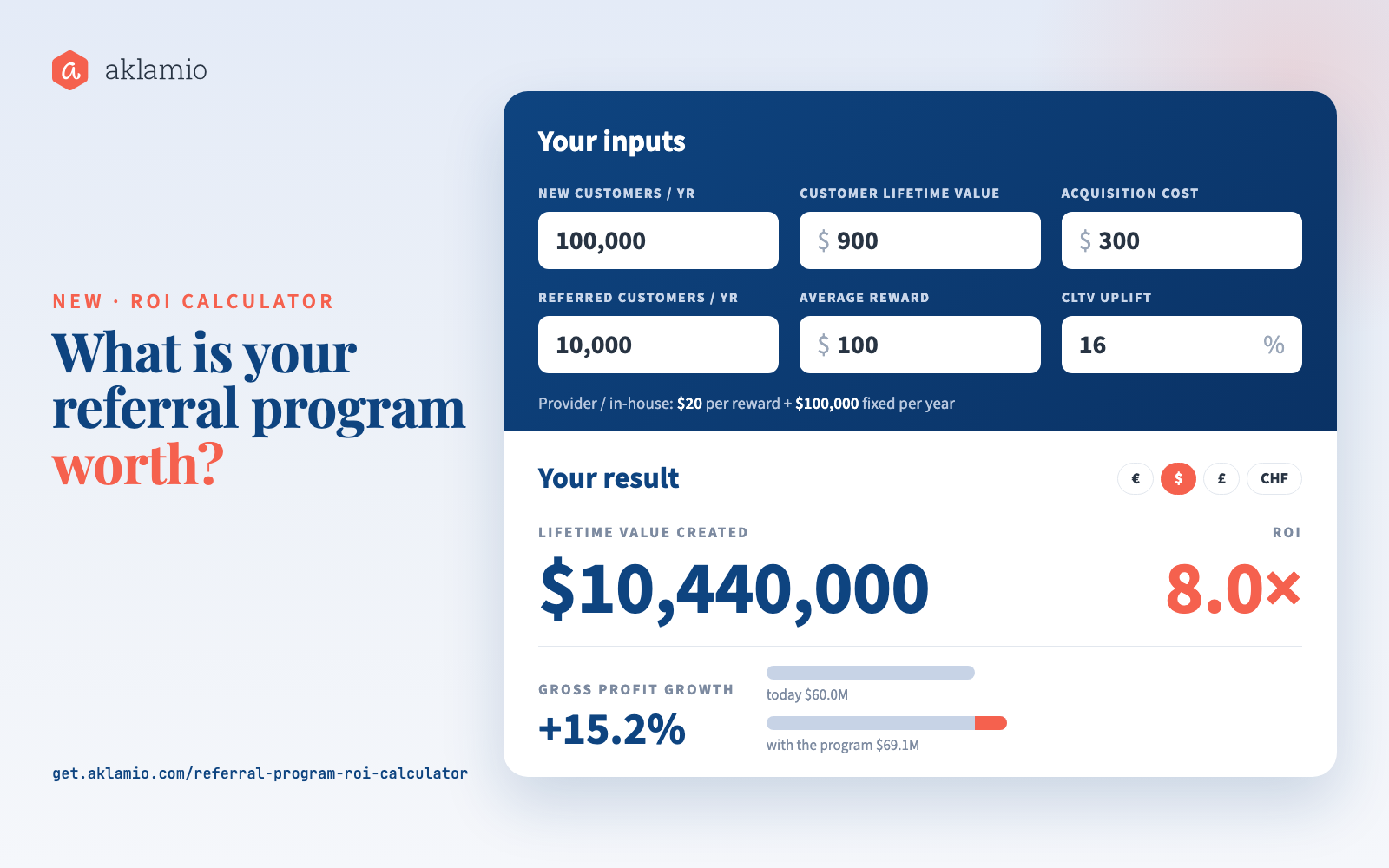
Here is what the calculator shows with its default values:
- New customers per year: 100,000
- Customer lifetime value: $900
- Current acquisition cost: $300
- Referred customers per year (10% of new customers): 10,000
- Average reward: $100
- CLTV uplift for referred customers: 16%
- Provider costs: $20 per reward + $100,000 per year
Lifetime value created: 10,000 referred customers × $1,044 uplifted CLTV = $10,440,000
Program cost: $1,000,000 in rewards + $300,000 provider costs = $1,300,000
ROI: $10,440,000 ÷ $1,300,000 = 8.0×
Gross profit growth: $9,140,000 contribution on top of $60,000,000 current gross profit = +15.2%
An ROI of 8× or more is common for referral programs, driven mainly by the generated sales uplift in combination with the higher lifetime value of referred customers. Even at $300,000, provider costs are small next to $10.4M in lifetime value created. In other words, an expert, high-performing solution will nearly always be worth the investment compared to a cheaper, lower-performing provider or a limited in-house solution. Just one percentage point more referred customers (11% instead of 10% of new customers) means about $1M more lifetime value for you.
So, getting back to my initial statement: while discussing provider costs is important, spend at least as much time on how a provider will help you maximize referral sales.
What the model deliberately leaves out
Not every referred customer is new growth. Some would have bought from you anyway. At the same time, many referred customers get attributed to other channels, e.g. because they googled your brand after a friend's recommendation. How much of each happens depends on your setup.
The calculator does not try to guess this for you. It is the part we prefer to go through together on a first call, with numbers from programs similar to yours.
Move budget to where it pays back
Paid search and social will always have a place in the mix. But they are getting more expensive, and every dollar there competes with every other advertiser in your category. Your existing customers are a channel nobody else can bid on.
So run your numbers. And if the result looks anything like the example above, it is worth asking how much of your Google and Meta budget should move into user-led growth.
Calculate your referral program ROI →
Want us to check your numbers? Book a demo and we will go through your business case, including incrementality, attribution and reward economics per channel.
Aklamio is the world's #1 Customer Incentive Platform. Operators, insurers, banks and utilities run their referral, acquisition and retention programs on Aklamio, with rewards in 50 markets.

Related posts

Seasonal sales psychology: how incentives can influence customer decision-making
Seasonal sales periods, whether spring campaigns, summer promotions, or year-end peaks, are driven as much by psychology as by pricing.

10 ways referral and cashback marketing outperform traditional acquisition channels
Customer acquisition is becoming more complex and more expensive.

From summer slowdown to September growth: use incentive marketing to restart customer acquisition
Summer often brings a predictable dip in customer engagement. Purchasing cycles slow down, and marketing campaigns can lose momentum. But September marks a distinct shift.